
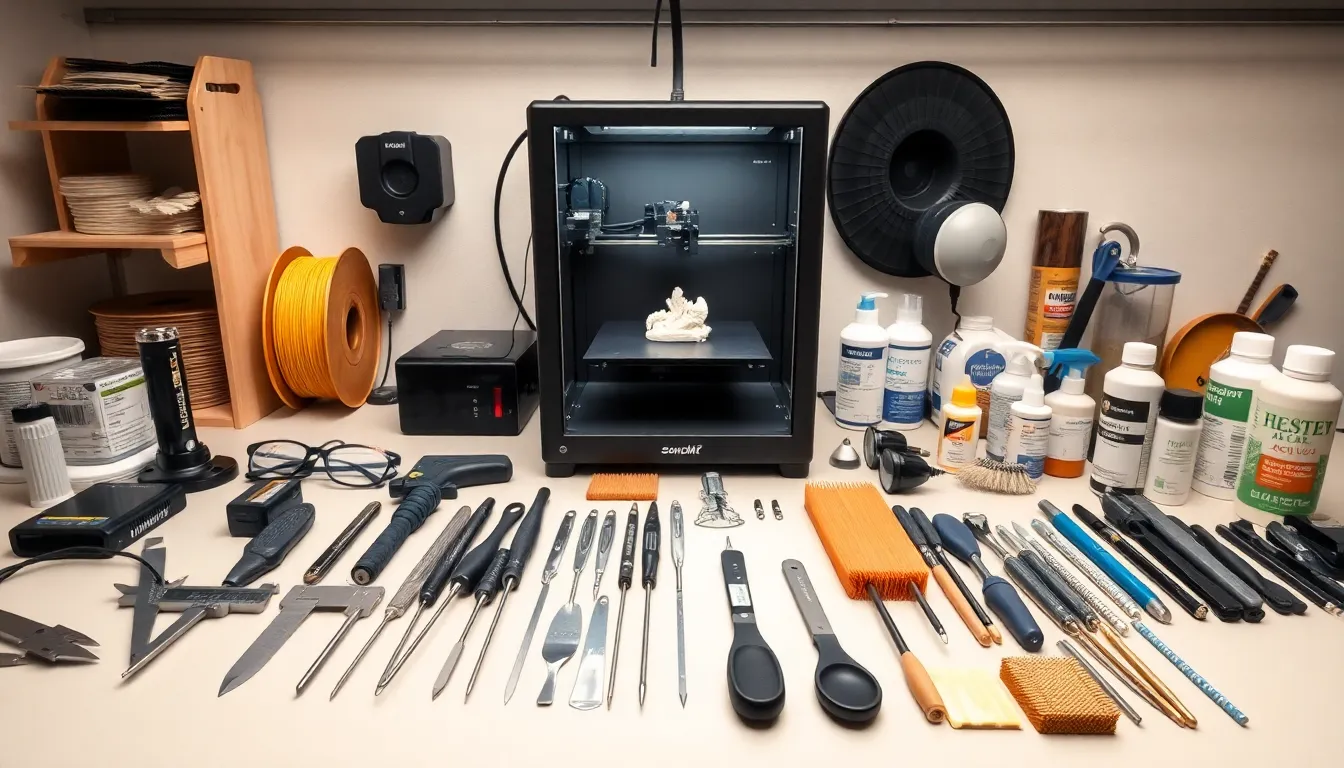
Every successful 3D print starts with the right 3D printing tools. A quality printer alone won’t guarantee great results. Makers need a collection of essential tools to prepare prints, finish them properly, and keep their machines running smoothly.
This guide covers the must-have 3D printing tools for every stage of the process. From bed adhesion helpers to safety gear, these items separate frustrating failures from professional-quality prints. Whether someone is new to additive manufacturing or has years of experience, having the right tools on hand makes all the difference.
Table of Contents
ToggleKey Takeaways
- Essential 3D printing tools span four categories: preparation, post-processing, maintenance, and safety equipment.
- Bed adhesion tools like PEI sheets, glue sticks, and isopropyl alcohol prevent warping and failed prints.
- Flush cutters, sandpaper (120–2000 grit), and needle files transform raw prints into polished, professional-quality pieces.
- Brass wire brushes, cleaning filament, and digital calipers keep your 3D printer accurate and running smoothly.
- Safety gear—including respirators, nitrile gloves, and safety glasses—protects against fumes, chemicals, and sharp debris.
- Having the right 3D printing tools on hand reduces frustration and dramatically improves print quality at every stage.
Preparation and Bed Adhesion Tools
Good bed adhesion prevents warping, lifting, and failed prints. Several 3D printing tools help achieve that critical first layer.
Print Bed Surfaces
A quality build surface gives prints something to grip. PEI sheets offer excellent adhesion for most filaments without additional help. Glass beds provide a perfectly flat surface and easy print removal once cooled. Flexible magnetic build plates let users bend the surface slightly to pop prints off without scraping.
Adhesion Helpers
Sometimes the build surface needs extra help. Glue sticks work well for PLA and PETG on glass beds. Hairspray creates a thin tacky layer that many makers swear by. Blue painter’s tape remains a classic option, especially for PLA. For high-temperature materials like ABS, specialized adhesive sprays provide the grip needed to prevent warping.
Leveling and Preparation Aids
A feeler gauge set helps dial in bed leveling with precision. Most makers use a 0.1mm or 0.2mm gauge to set the gap between nozzle and bed. Isopropyl alcohol (90% or higher) cleans oils and residue from the build surface. A clean bed sticks better, period. Some users keep a dedicated microfiber cloth just for this purpose.
Spatulas and Scrapers
A good print removal tool is essential. Thin, flexible spatulas slide under prints without damaging the bed surface. Some makers prefer palette knives for their sharpness. Plastic scrapers work well on PEI to avoid scratches. Having multiple options matters because different prints release differently.
Post-Processing and Finishing Tools
Raw prints rarely look perfect straight off the bed. Post-processing 3D printing tools transform rough outputs into polished pieces.
Cutting and Trimming Tools
Flush cutters remove supports cleanly. These snip right at the base without leaving ugly nubs. A sharp hobby knife handles fine detail work and cleans up small imperfections. Needle-nose pliers help break away support material from tight spots.
Sanding Supplies
Sanding removes layer lines and smooths surfaces. Start with 120-grit sandpaper for heavy work, then progress through 220, 400, and 600 grit for finer finishes. Wet sanding with higher grits (800-2000) produces near-glass smoothness on some materials. Sanding sponges conform to curved surfaces better than flat paper. For resin prints, sanding requires proper safety precautions due to uncured resin particles.
Filing Tools
Needle files handle detail work that sandpaper can’t reach. A basic set includes flat, round, half-round, and triangular profiles. These clean up holes, slots, and tight corners. Metal files also help when parts need to fit together precisely.
Gap Filling and Bonding
Super glue (CA glue) bonds 3D printed parts quickly. The thin variety wicks into cracks and seams. Thicker formulas fill small gaps. For larger repairs, automotive body filler or specialized 3D print filler works well. Two-part epoxy creates the strongest bonds for load-bearing assemblies.
Maintenance and Calibration Tools
3D printers need regular maintenance. The right 3D printing tools keep machines accurate and reliable.
Cleaning Tools
Brass wire brushes clean nozzles without scratching them. Steel brushes damage brass nozzles, so material matters here. Cleaning filament removes carbonized residue from inside the hotend. Cold pulls (using nylon filament) extract stubborn clogs. Cotton swabs and isopropyl alcohol clean sensors, rails, and other components.
Nozzle Maintenance
Acupuncture needles or specialized nozzle cleaning needles clear partial clogs. These thin tools fit inside standard 0.4mm nozzles. A socket wrench or proper nozzle wrench removes and installs nozzles safely. Torque matters, too loose causes leaks, too tight damages threads. Spare nozzles in various sizes (0.2mm, 0.4mm, 0.6mm, 0.8mm) allow flexibility for different print jobs.
Calibration Equipment
Digital calipers measure prints accurately to verify dimensional accuracy. They also measure filament diameter to ensure it matches the slicer settings. A digital thermometer verifies hotend and bed temperatures against what the printer reports. A quality bubble level helps square the frame on some machines.
Safety Equipment for 3D Printing
3D printing involves heat, fumes, and sharp objects. Proper safety gear protects makers from common hazards.
Respiratory Protection
FDM printers release ultrafine particles and volatile organic compounds. A well-ventilated workspace is the first defense. HEPA-filtered enclosures capture particles effectively. When printing ABS, ASA, or other high-emission materials, a respirator with organic vapor cartridges adds protection. Resin printers demand even more caution, always use proper ventilation and consider a respirator during post-processing.
Hand Protection
Heat-resistant gloves protect hands when handling hot beds and freshly printed parts. Nitrile gloves are essential for resin printing to prevent skin contact with uncured photopolymers. Even with FDM, gloves help when handling sharp support material or applying finishing chemicals.
Eye Protection
Safety glasses prevent injury from flying debris during support removal or sanding. UV-blocking glasses matter for resin printers, as the curing light can damage eyes. Some enclosures include UV-blocking panels, but glasses add an extra layer of protection.
Fire Safety
3D printers use heating elements that can reach 250°C or higher. A smoke detector near the printer provides early warning. Some makers keep a fire extinguisher rated for electrical fires nearby. Never leave printers running unattended in enclosed spaces without proper monitoring.