
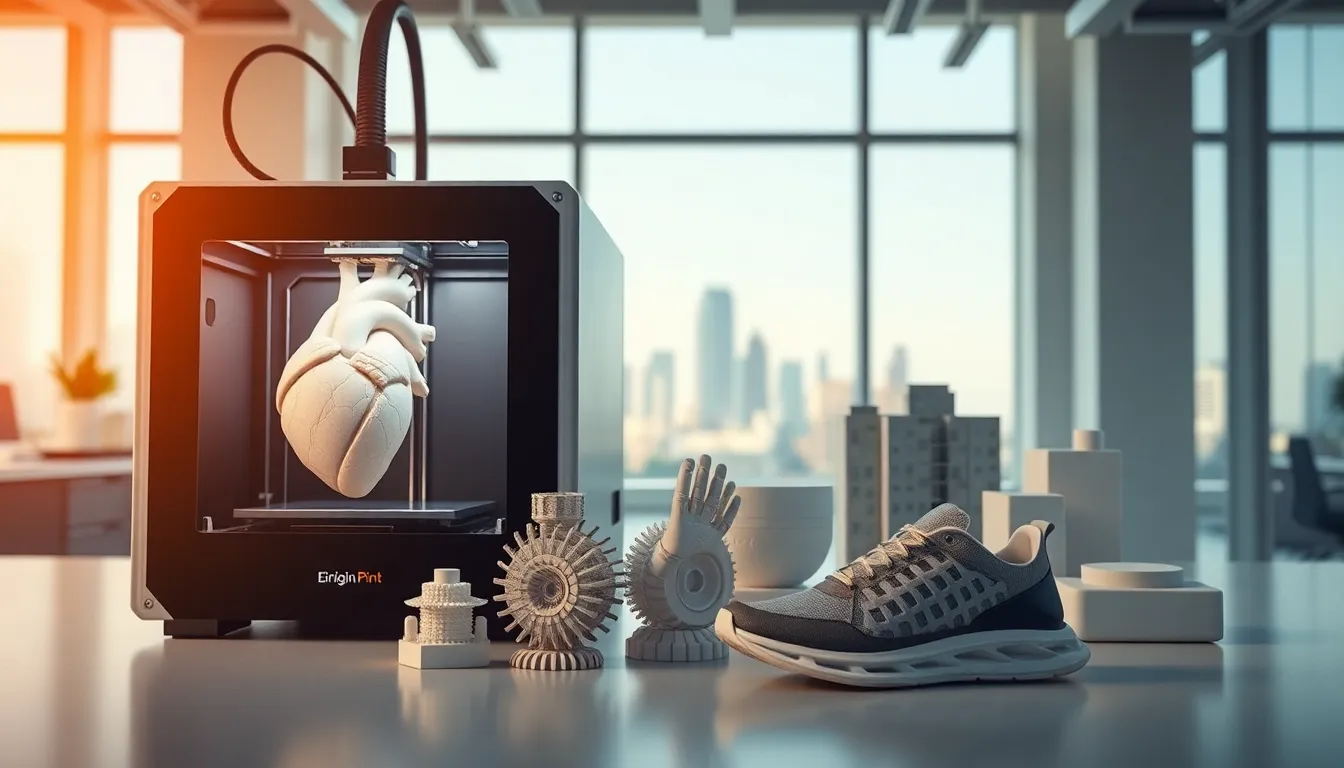
3D printing examples show up in places most people never expect. A surgeon prints a replica of a patient’s heart before a complex operation. An aerospace engineer produces lightweight jet engine parts that traditional manufacturing can’t create. A fashion designer debuts a fully printed dress on a Paris runway.
This technology has moved far beyond hobbyist workshops and prototyping labs. 3D printing now shapes how industries design, build, and deliver products. From custom prosthetics to entire houses, the applications keep expanding.
This article covers real-world 3D printing examples across six major sectors. Each section highlights specific use cases, benefits, and the practical impact this technology delivers today.
Table of Contents
ToggleKey Takeaways
- 3D printing examples span six major industries—healthcare, aerospace, automotive, construction, consumer products, and education—proving the technology’s wide-reaching impact.
- Custom prosthetics and dental implants showcase how 3D printing delivers patient-specific solutions faster and at lower cost than traditional manufacturing.
- Aerospace leaders like GE and SpaceX use 3D printing to create lighter, stronger parts—such as fuel nozzles that weigh 25% less and last five times longer.
- Construction companies now 3D print entire homes in under a week, reducing labor costs and construction waste significantly.
- Consumer brands like Adidas and Nike offer 3D printed footwear, bringing mass customization to everyday shoppers.
- Rapid prototyping with 3D printing allows engineers to design, test, and iterate products in a single day—dramatically accelerating innovation.
Healthcare and Medical Applications
Healthcare offers some of the most impressive 3D printing examples in use today. The technology enables patient-specific solutions that traditional manufacturing simply cannot match.
Custom Prosthetics and Implants
Traditional prosthetics require multiple fittings and lengthy production times. 3D printing changes this equation. Companies now scan a patient’s anatomy and produce custom-fitted prosthetic limbs within days. The cost drops significantly too, some organizations create functional prosthetic hands for under $50.
Dental implants represent another major application. Dentists use 3D printing to produce crowns, bridges, and aligners matched precisely to each patient’s mouth. Invisalign, for instance, manufactures millions of custom aligners annually using 3D printing technology.
Surgical Planning and Bioprinting
Surgeons at major hospitals print anatomical models before complex procedures. A cardiac surgeon might print an exact replica of a patient’s heart to plan an operation. This preparation reduces surgical time and improves outcomes.
Bioprinting pushes even further. Researchers print living tissue using bio-inks containing human cells. While fully functional 3D printed organs remain years away, scientists have successfully printed skin grafts, cartilage, and simple tissue structures. These 3D printing examples hint at a future where organ donor shortages could become obsolete.
Aerospace and Automotive Manufacturing
Aerospace and automotive companies have adopted 3D printing at scale. The benefits include lighter parts, faster production, and designs impossible to achieve with traditional methods.
Aerospace Innovation
GE Aviation prints fuel nozzles for its LEAP jet engines. These 3D printed nozzles weigh 25% less than previous versions and last five times longer. Each nozzle consolidates 20 separate parts into one component.
SpaceX uses 3D printing to produce SuperDraco engine chambers. NASA prints rocket engine components and tools for the International Space Station. The ability to manufacture parts on-demand in space represents a game-changing capability for long-duration missions.
Automotive Applications
Automakers use 3D printing throughout the vehicle development process. Ford prints prototype parts that would take weeks to machine traditionally. Porsche creates replacement parts for classic cars no longer in production.
Bugatti produced 3D printed titanium brake calipers for its Chiron supercar. These calipers weigh 40% less than aluminum versions while handling extreme temperatures and forces. Local Motors went further, they built an entire car, the Strati, using large-scale 3D printing.
These 3D printing examples demonstrate how the technology reduces weight, cuts production time, and enables previously impossible geometries.
Architecture and Construction
Construction represents one of the fastest-growing areas for 3D printing examples. Large-scale printers now produce entire buildings, bridges, and infrastructure components.
3D Printed Buildings
ICON, a Texas-based company, prints affordable homes using a proprietary concrete mixture. Their Vulcan printer system creates a 2,000-square-foot home in under a week. The technology dramatically reduces labor costs and construction waste.
In the Netherlands, Project Milestone produced the first legally occupied 3D printed concrete house in 2021. Dubai set an ambitious goal: 25% of new buildings will use 3D printing technology by 2030.
Infrastructure and Design Freedom
Amsterdam unveiled a fully 3D printed steel pedestrian bridge in 2021. Robotic arms deposited molten metal layer by layer to create the 40-foot structure.
Architects embrace 3D printing for the design freedom it offers. Complex organic shapes, intricate lattice structures, and custom facades become economically viable. A design that might require expensive custom molds traditionally can simply print directly.
These 3D printing examples show construction shifting from a labor-intensive industry toward automated, precise manufacturing.
Consumer Products and Fashion
Consumer goods and fashion industries showcase creative 3D printing examples that reach everyday shoppers.
Footwear and Apparel
Adidas sells the 4DFWD running shoe featuring a 3D printed midsole. The lattice structure provides targeted cushioning impossible to achieve with traditional foam. New Balance and Nike also offer 3D printed footwear options.
Fashion designers experiment with printed garments, accessories, and jewelry. Dutch designer Iris van Herpen creates sculptural dresses using selective laser sintering. These pieces push the boundaries of wearable art.
Home Goods and Customization
IKEA experimented with 3D printed furniture accessories designed for people with disabilities. Companies like Formlabs enable small businesses to print custom jewelry, eyewear, and household items.
The real power lies in mass customization. A customer can order sunglasses fitted to their exact face shape or earbuds molded to their ear canals. This level of personalization previously required expensive custom manufacturing.
These 3D printing examples illustrate how the technology moves from industrial applications into consumer hands.
Education and Prototyping
Education and product development rely heavily on 3D printing. The technology transforms how students learn and how companies bring ideas to market.
Classroom Applications
Schools use 3D printing to make abstract concepts tangible. A biology teacher prints anatomical models students can hold and examine. A history class recreates ancient artifacts. Engineering students design and print functional mechanisms.
Universities integrate 3D printing across disciplines. Architecture students print building models. Medical students practice on anatomical replicas. The hands-on experience accelerates learning in ways textbooks cannot match.
Rapid Prototyping
Product designers call 3D printing “rapid prototyping” for good reason. An engineer can design a part, print it, test it, and iterate, all within a single day. Traditional prototyping might require weeks of machining or expensive tooling.
Startups benefit enormously from this speed. A hardware company can test dozens of design variations before committing to mass production. The cost of failure drops dramatically when each prototype costs a few dollars instead of thousands.
These 3D printing examples show how accessible the technology has become. A $200 desktop printer can produce functional prototypes that compete with professional-grade equipment from just a decade ago.